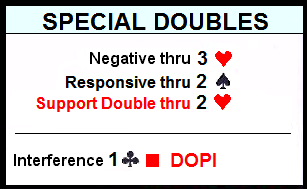
 Negative Double

Support Double
I don't know why the ACBL says this bid is alertable when the Responsive Double is not.
I think this agreement works much better with other bidding systems, especially when the heart suit is involved. Anyway, if I open the bidding 1
 and my partner responds
with a major suit then I can use this convention to show 3-card support when the next hand
interferes. A double or redouble indicates 3-card support while an immediate
raise shows 4-card support.
and my partner responds
with a major suit then I can use this convention to show 3-card support when the next hand
interferes. A double or redouble indicates 3-card support while an immediate
raise shows 4-card support.
The problem is that we sometimes respond to 1
with a 3-card heart suit.
I doubt we should be using Support Doubles after a heart response, but so far it hasn't
created a disaster. (When it does, we will probably change this.)
DOPI
This is a special double used when partner opens 1
 and the opponents
overcall. It's a method of conveying how many controls responder is holding.
The DOPI acronym is in two parts: DO means Double with Zero while PI
means Pass with One. Bidding the next ranking suit is an artificial step response
showing two controls, etc.
and the opponents
overcall. It's a method of conveying how many controls responder is holding.
The DOPI acronym is in two parts: DO means Double with Zero while PI
means Pass with One. Bidding the next ranking suit is an artificial step response
showing two controls, etc.
We use this method in another sequence, too. When one of us opens a major and the other responds with a simple raise which is game forcing, we use DOPI if the next hand makes an interference bid.